Identity
| Reported fragment | Residues 17–23 of thymosin beta-4 |
|---|---|
| Modification in cited sample | N-terminal acetylation |
| Reference compound | TB-500 (published acetylated fragment) |
| CAS number | 885340-08-9 |
| Molecular formula | C38H68N10O14 |
| Molecular weight | 889.0 g/mol |
| Source | PubChem CID 62707662 |
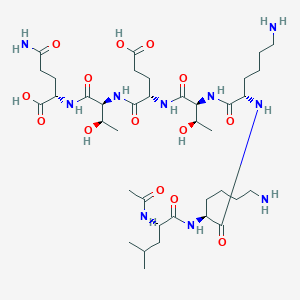
Overview
The TB-500 fragment is a synthetic, acetylated seven-amino-acid peptide based on a segment of naturally occurring thymosin beta-4. Fragment-specific studies examine peptide metabolism and gap closure in fibroblast cultures.[1]
Published research
Analytical study · Identifying the fragment
Researchers used chemical analysis to identify the N-terminally acetylated fragment corresponding to residues 17–23 of thymosin beta-4. This distinction matters because papers on actin binding frequently tested the entire 43-residue chain. The investigators identified the acetylated seven-residue sequence Ac-LKKTETQ in the TB-500 preparation they analyzed.[1]
Cell study · Parent fragment and metabolites
In a fibroblast scratch assay, the investigators compared the fragment with products formed during its breakdown. The parent fragment showed no significant increase in gap closure, whereas a metabolite produced greater closure under the study conditions. The investigators detected no cytotoxicity from the parent or its tested metabolites under the assay conditions. The parent fragment showed no significant increase in fibroblast gap closure relative to the control, whereas its shorter metabolite Ac-LKKTE produced a small, statistically significant increase.[2]
Dosing
Research doses
A 2024 rat and cell paper (PMID 38382158) compared the parent fragment with shorter metabolites in a fibroblast gap assay. The open abstract does not state the concentration applied to the cells, so that assay is not given a dose row. It reports no cytotoxicity, no significant gap-closure increase for the parent, and a significant increase for the shorter metabolite Ac-LKKTE.
| Study | Model | Dose | Route | Duration |
|---|---|---|---|---|
| Ho et al., Journal of Chromatography A, 2012 | Horses | A single administration of a preparation containing 10 mg of N-acetylated LKKTETQ | Not stated in the open abstract · Once | Post-administration urine and plasma were collected; the abstract does not give the sampling schedule |
Side effects reported in studies
Names below are adverse findings stated in the cited studies, or, when at least 10 independent firsthand reports name them, a count from those reports. They are not a complete list and not guidance for human use.
None named in the studies cited on this page.
Anecdotal / user experience
Reported dose ranges
Insufficient reports from the PeptiRef firsthand sample (fewer than 10).
Commonly cited community protocol — source: Peptide Dosing Protocols (peptidedosingprotocols.com). Accessed 29 November 2026. Source page
| Amount listed | Frequency listed | Duration listed | Route listed |
|---|---|---|---|
| 2–2.5 mg | Twice weekly, then once weekly | Higher frequency described for about 4–6 weeks, then a lower-frequency period | Subcutaneous, as listed |
Reported dose progression
Commonly cited community protocol — source: Peptide Dosing Protocols (peptidedosingprotocols.com). Accessed 29 November 2026. Source page. The phases are the steps that page lists. They are not a recommendation and not for human use.
| Phase / week | Amount as listed | Frequency | Notes |
|---|---|---|---|
| Loading, weeks 1–6 | ~2–2.5 mg | Twice weekly | Load-and-maintain pattern. The same table lists about 4–5 mg per week. The page’s dosage chart also lists a loading window of about 4–6 weeks. |
| Maintenance, weeks 7–12 | ~2–2.5 mg | Once weekly | Same load-and-maintain pattern. The table lists about 2–2.5 mg per week. |
| Off period, 4–8 weeks | 0 mg | None listed | Listed after maintenance on that same pattern. |
| Front-loading, weeks 1–2 | ~2–2.5 mg | Every 2–3 days | Separate acute-window pattern listed on the page, not a continuation of the weeks 1–12 pattern. |
| Taper, weeks 3–8 | ~2–2.5 mg | Once weekly | Continuation of that acute-window pattern. |
Reported effects
Retrieval on 29 Nov 2026 from the Arctic Shift archive of public r/Peptides submissions (search limit 20–40 posts per compound query). A report was counted only when the text was a firsthand description of something the author had already noticed, the compound was a subject of that description, and the post was not a dosing compilation, a how-to, or a statement of future plans. One post was counted once, on the compound it was about. Posts that only described a blend were not split into ingredient counts. Compilations were excluded. A percentage is shown only when 10 or more reports met those rules.
Insufficient reports.
Commonly self-reported side effects
PeptiRef’s firsthand sample is under 10, so no share is calculated. The names below are listed by Peptide Dosing Protocols. Accessed 29 November 2026. Source page
- Injection-site discomfort Peptide Dosing Protocols, accessed 29 November 2026
- Redness Peptide Dosing Protocols, accessed 29 November 2026
- Fatigue Peptide Dosing Protocols, accessed 29 November 2026
- Head pressure Peptide Dosing Protocols, accessed 29 November 2026
Frequently asked questions
Is TB-500 the same molecule as full-length thymosin beta-4?
No, when TB-500 refers to the published seven-amino-acid acetylated fragment. Full-length thymosin beta-4 contains 43 amino acids. The short fragment lacks much of the full chain, so full-length studies cannot establish the fragment’s effects.[1]
What does Ac-LKKTETQ mean?
The letters identify the seven amino acids in the fragment studied, and Ac indicates an acetyl group at the beginning of the chain. The acetylated fragment is chemically different from an unmodified fragment.[1]
Why do researchers study TB-500 breakdown products?
As a peptide breaks down, shorter molecules can form. A 2024 study tested these products separately to find out whether the original fragment and its metabolites produced the same cell response.[2]
Did TB-500 itself close the gap in the 2024 cell study?
The parent fragment did not significantly increase gap closure in that experiment. A shorter breakdown product, Ac-LKKTE, was the only tested compound with a statistically significant increase compared with the control.[2]
What does a scratch assay tell researchers about TB-500?
A scratch assay tracks how a gap in a layer of cells closes in a dish. It can reflect cell movement or other changes. A closing gap does not establish wound strength or healing in a living person.[2]